S-chess endings 4 GM yasser-seirawan 2024-03-01 87 views en The Elephant My article this month is dedicated to Noam D. Elkies. He inspired me greatly by cooking my Elephant study. In my first Endgame article I gave the following study and comments: "What is interesting is that the Elephant can win against the Rook without necessarily "forcing" the defender to the last rank. The diagram position features the pattern that I have in mind: 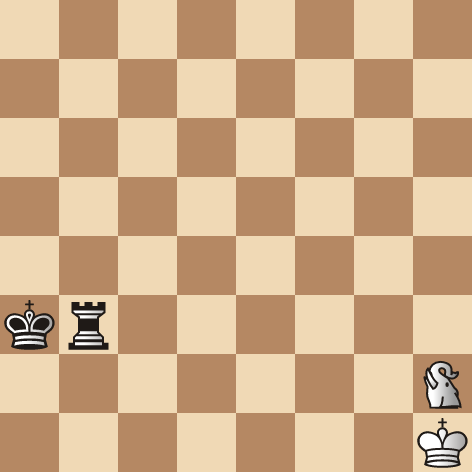{width=336 height=336} Study Seirawan 2007 White to play and win The study has a double twist. White is to mate Black on both the a1 and a8-squares. The pattern is amusing. Before reading onwards and seeing the solution, set up the diagrammed position on your chess board and see if you can solve it." White starts with a check: **1.Ec2+** **Ka4** **2.Ec4+!**, Black is forced to interpose his Rook as the King move **2...Kb5** leads to **3.Ed4+** forking and winning the Rook: **2...Rb4** **3.Ec3+!**, repeating the pattern and driving Black's King to towards the a8-square: **3...Ka5** **4.Ec5+!** **Rb5** **5.Ec4+!** **Ka6** **6.Ec6+** **Rb6** **7.Ec5+** **Ka7** **8.Ec7+** **Rb7**, as we've seen in case of: **8...Kb8** **9.Ed7+** forks King and Rook, **9.Ec6+** **Ka8**, mission accomplished. Now the mate is but two moves away: **10.Ec8+** **Rb8**, a forced interposition, **11.Ec7** checkmate! Remarkable. White is able to force a checkmate without the involvement of his King. Put the study on your board once more and now try to force a checkmate on the a1-square... Here the trick is to remember that White's King is on the h1-square so that a twist in the pattern is needed: **1.Ec2+** **Ka4** **2.Ec4+** **Rb4** **3.Ec5+!**, a reversal of the previous pattern. Now our goal is to drive Black's King to the a1-square: **3...Ka3** **4.Ec3+** **Rb3** **5.Ec4+** **Ka2** **6.Ec2+** **Rb2**, as we've seen **6...Kb1** **7.Ed2+** would cost Black his Rook. **7.Ec3+** **Ka1**, mission accomplished. Now we have to pause to think. Previously our pattern told us that, **8.Ec1+** **Rb1** **9.Ec2** would deliver checkmate. However, this pattern would be tragic: **8.Ec1+??** **Rb1!**. pins the Elephant to White's King! So White adjusts the pattern: **8.Ea3+!** **Ra2** **9.Eb3** checkmate. I found myself enchanted by these patterns..." Noam D. Elkies pointed out two beautiful stalemate ideas that cook my intended solutions: **1.Ec2+** **Ka4** **2.Ec4+** **Rb4** **3.Ec3+** **Ka5** **4.Ec5** **Rb5** **5.Ec4+** **Ka6** **6.Ec6+**. this is the moment that Noam points out that Black has the beautiful resource: **6...Kb7!!**, when the intended win by **7.Ed6+**, is undone by the move: **7...Ka8!**, and if the Rook is captured: **8.Exb5**, a stalemate is created. Noam also points out that the pattern can be repeated in case White tries a checkmate on the a1-square: **1.Ec2+** **Ka4** **2.Ec4+** **Rb4** **3.Ec5+** **4.Ec3+**, and now again the pattern is flipped: **4...Kb2!** **5.Ed6+** **Ka1!**, as before, if the Rook is captured: **6.Exb4**, again a stalemate is produced. I was delighted by these two cooks enjoying the patterns created immensely. Noam however was not finished. Once again we start with the original study and he found a winning solution after all: "Meanwhile, while pondering the position again a day or two later, I noticed that White seems to win after all with a different checking sequence: **1.Ec2+** **Ka4** **2.Ec5+!** **Kb4** (or _2...Ka3_ _3.Ec4+_ transposing) 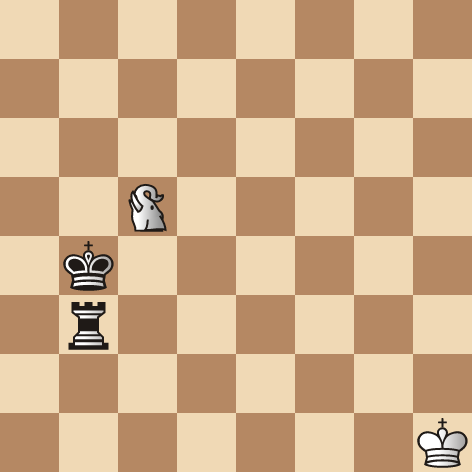{width=336 height=336} **3.Ee4+!** Now **3...Ka3** allows **4.Ec4+** **Ka2** **5.Ec2+**, when Black no longer has the stalemate trick and is either fatally forked after: **5...Kb1** **6.Ed2+** or mated after: **5...Rb2** **6.Ec3+** **Ka1** **7.Ea3+!** (_Ec1+?_) **Ra2** **8.Eb3**, checkmate. While **3...Kb5** allows the familiar fork **4.Ed4+**, and **3...Ka5** **4 Ec4+**, gives Black the Hobson's choice between the same fork and **4...Ka6** **5 Ec5+**, winning. As you can imagine I was elated with the cooks as well as the save! The study has been vastly improved thanks to Noam's work. But he wasn't done. He offered the following for consideration: "I suspect now that this King + Elephant versus King + Rook ending must be generally won by the Elephant side, because even without the White King there are so many forking possibilities. An amusing example:" 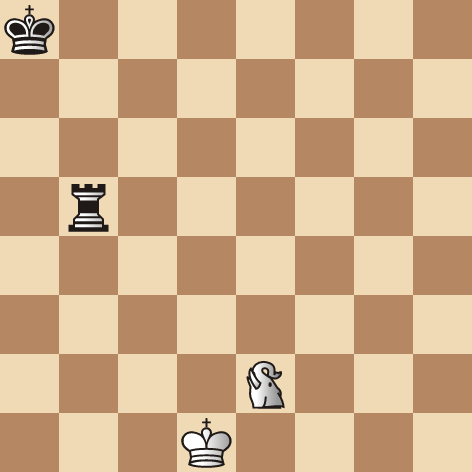{width=336 height=336} Study Noam D. Elkies 2007 White to play and win "If: **1.Ee8+** **Kb7** **2.Ed6+** **Ka8**, and again White is stymied at least for in the short term by the stalemate defense. But the non-checking move: **1.Ec3**, wins. The threat is not **2.Exb5?** but **2.Ea3+**; even that's only a phantom threat, because any Black move parries it, but wherever he goes Black either gets forked or falls into that systematic-mate line: **1...K-any** **2.Exb5+** **1...Ra5**(_e5_) **2.Ec7+** **Kb8** **3.Ec6+** **1...Rf5**(_h5_) **2.Ec7+** **Kb8** **3.Ee8+** and **4.Eg7+** **1...Rg5** **2.Ec7+** **Kb8** **3.Ed7+** **Kc8**(_a8_) **4.Ef8+**, and **5.Ef7+** (or _5.Eh7+_) **1...Rb8** **2.Ec7#** **1...Rb7** **2.Ec8+** **Rb8** **3.Ec7#** **1...Rb6** **2.Ec7+** **Kb8** **3.Ed7+** **1...Rb4**(_b2_) **2.Ea2**(_a4_)**+** Some lines have alternative conclusions, e.g. **1...Rb4** **2.Ec7+** and **3.Ec6+**." Noam D. Elkies Talk about a Kasparian domination theme! How about that one? Very nice indeed. Thank you very much Noam D. Elkies! I couldn't have written this article without your help. Smile. 0 Likes You may also like S-Chess Endings 3 The Hawk S-Chess Endings 2 The Hawk S-chess endings 1 The Elephant